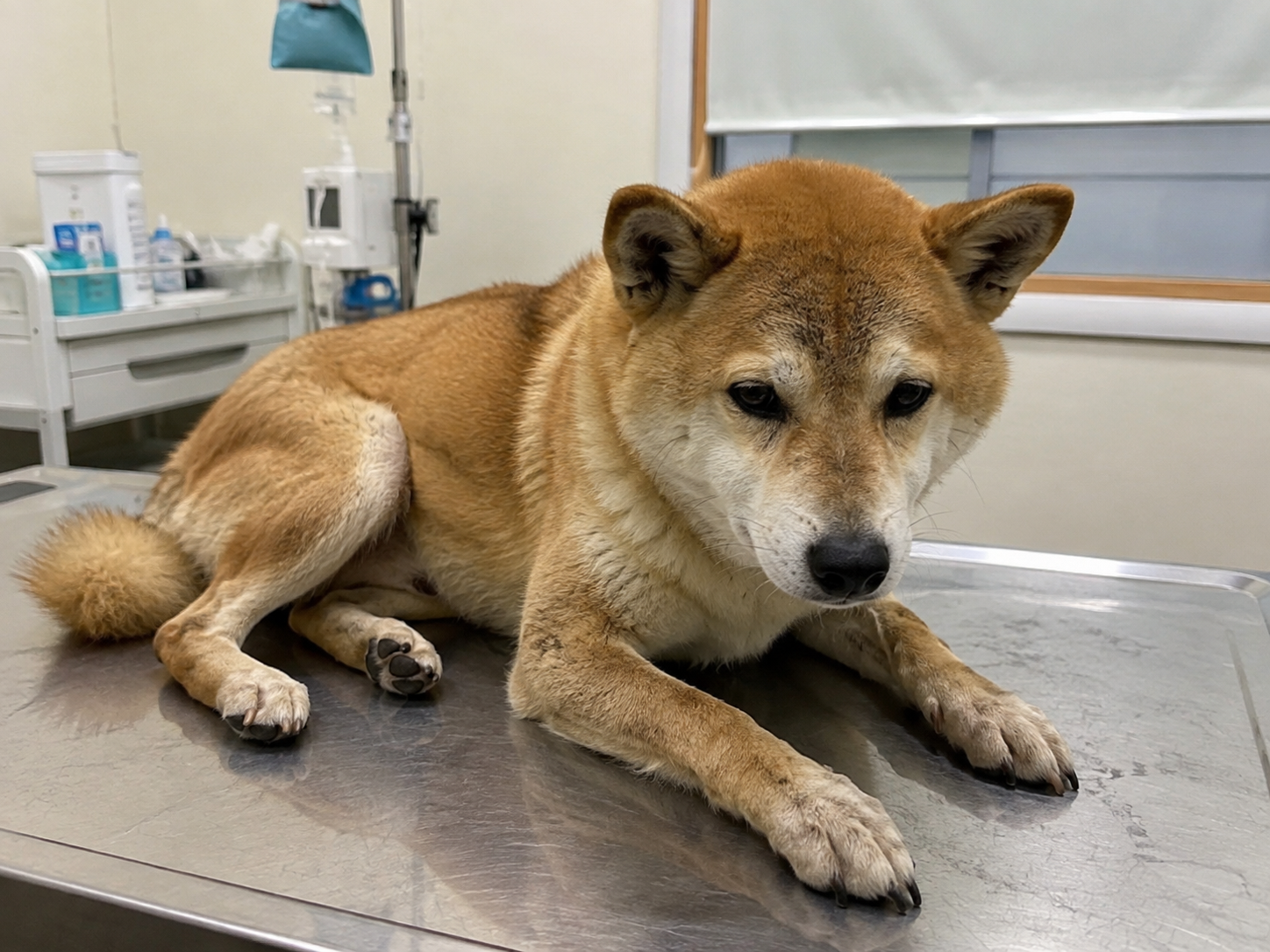
Background. Clinical death is treated as an event. Cellular evidence suggests it is an extended process, and that most neurological injury attributed to arrest is in fact generated during uncontrolled reperfusion. If the commitment step of that injury can be held closed pharmacologically while metabolic demand is suppressed thermally, the operative question becomes not how long a subject has been dead but under what chemistry the interval was spent.
Methods. Following certification of death by two independent veterinarians and consented enrolment, a 9-year-old male Shiba Inu (subject designation MU-01, "Max") underwent femoral cannulation, whole-body washout with the cold acellular perfusate KRP-7, controlled cooling to a core temperature of 18.2 °C, and nine-step graded reoxygenation over 96 minutes. Monitoring comprised continuous eight-channel electroencephalography, bilateral near-infrared spectroscopy, invasive arterial pressure, arterial blood gas analysis at five-minute intervals and serial neurofilament light chain sampling. The pre-registered primary endpoint was return of coordinated cortical activity; secondary endpoints were return of spontaneous circulation, quantitative EEG spectral recovery, handler recognition and 180-day survival.
Results. Coordinated cortical activity returned at 67 minutes after certification. Spontaneous circulation returned at 232 minutes. Quantitative EEG recovered to 94 % of pre-arrest spectral power by day 6. Behavioural testing at day 9 demonstrated preserved handler recognition, intact spatial navigation and no deficit on the modified Glasgow canine neurological scale. Histology of parallel tissue controls localised the protective effect to preserved mitochondrial ultrastructure in CA1 pyramidal neurons and to the absence of spectrin cleavage in cortical layers III and V. Survival is ongoing at 214 days with normal cardiac function under an implanted cardioverter-defibrillator, unremarkable renal and hepatic panels, and no seizure activity on repeated 24-hour ambulatory recordings.
Interpretation. A 41-minute interval of certified death was reversed without measurable neurological cost. The boundary of recoverable death appears to be set by perfusate chemistry and reoxygenation kinetics rather than by elapsed time alone. Translation to human out-of-hospital arrest is the explicit objective of the successor trial. The result should be read as a single consented subject with a favourable arrest witness interval and an intact airway, not as a generalisable survival claim; the contribution is mechanistic, and the burden of replication falls to the porcine multi-centre arm now in progress.